Is Your Workout Stalling Belly Fat Loss?
The secret to losing stubborn belly fat that no one else is focusing on.
If you've been searching for at-home workouts for women, trying to lose belly fat, or wondering if cycle syncing workouts are worth the hype, you're probably feeling confused about what actually works.
You’re either giving 100% every time you work out, or stuck in the search phase with no idea where to start.
Either way, you're feeling like you’re stuck in a body that isn't yours.
I've been there, too. Years ago, I got a one-week pass to a bootcamp gym and thought, "I'm going to get my money's worth." So I signed up for class after class, walking out of every one feeling accomplished for showing up and giving A+ effort.
But by the end of the week, instead of feeling stronger and leaner, I felt puffy, inflamed, and completely drained. That week planted a seed I couldn't ignore:
There was a difference between what my mind thought was healthy and what my body was actually asking for.
Mentally, I felt proud for pushing through and staying disciplined. But physically, my body was waving a giant red flag.
The problem is: we've been taught to override our bodies with what we think is best instead of listening to them.
Why Regular Workout Advice "Eat Less, Move More" is Wrong
If you're anything like me, you've probably been taught that getting results comes down to one simple formula: eat less, move more, and stay consistent.
Yes, there is value in consistency. But somewhere along the way, consistency became confused with doing the exact same thing every single day, no matter how your body feels. The underlying message has become: treat your body like a calculator. Count calories, work out, and be in a calorie deficit.
Here's where the disconnect is:
Your body isn't just responding to your workout, but also to its entire environment… and that's not just your food and workouts.
Your body is a living system responding to your lifestyle habits, stress load, and nervous system state:
How well you slept the night before.
Whether you've been skipping meals.
If work has been especially stressful.
Where you are in your menstrual cycle.
How much you've been going through emotionally.
Whether you've had enough time to recover from yesterday's workout.
Many of the changes you're hoping your workout will create don't actually happen during the workout. They happen afterward, depending on how well your body adapts and recovers.
The Problem: A Warped Sense of "Consistency"
That's where so many women get stuck. We've been taught to trust the plan more than we trust our own bodies.
We override hunger because we think we should wait until lunch. We ignore exhaustion because missing a workout feels like failure. We push through soreness because we've been told that's what growth feels like.
Eventually, we stop paying attention to the signals our bodies are sending altogether in the name of "consistency." We've been expecting our bodies to perform the same way every single day, when they were never designed to.
When your body doesn't feel like it has enough resources to grow, it does the wiser thing: it protects. So instead of putting its energy toward growth, it puts its attention toward protection, where metabolism tanks and weight loss gets hard.
Even though hard effort looks and feels productive, biologically, the body gears toward protection and survival.
3 Questions to Ask Before Every Workout
One of the biggest shifts I made was realizing we need a better way to decide which workout our bodies would actually benefit from that day, because our hormones are always changing. This is where cycle-syncing workouts come into play, and where workouts contribute to nervous system regulation.
(This method works even if you don't have a cycle, or are in perimenopause — you just focus on energy cues instead.)
Think about nature. It never stays in one season. Spring prepares for summer, summer prepares for fall. Every season has a purpose because it prepares for what's next. Our bodies work the same way.
Our hormones, energy, and recovery naturally ebb and flow. Some days your body has a greater capacity, other days it's asking you to restore. The workout that builds you up in one phase may deplete you in another, so it's important to give your body what it needs in that moment so it can prepare for and perform at its best in the next phase.
I've categorized these hormone/energy phases that build on each other:
🧘🏻♀️ RESTORE: Supportive mobility and recovery movement.
🌊 FLOW: Low-impact activities and barre flows that still get your heart rate up.
💪🏼 POWER: Workouts that focus on challenges and building strength in the body.
With this approach, you're not just tuning into your mood, but more importantly, your biology.
When you meet your body where it's at and give your body challenges or restoration at the right time, your body sees the best results because it can adapt and move forward.
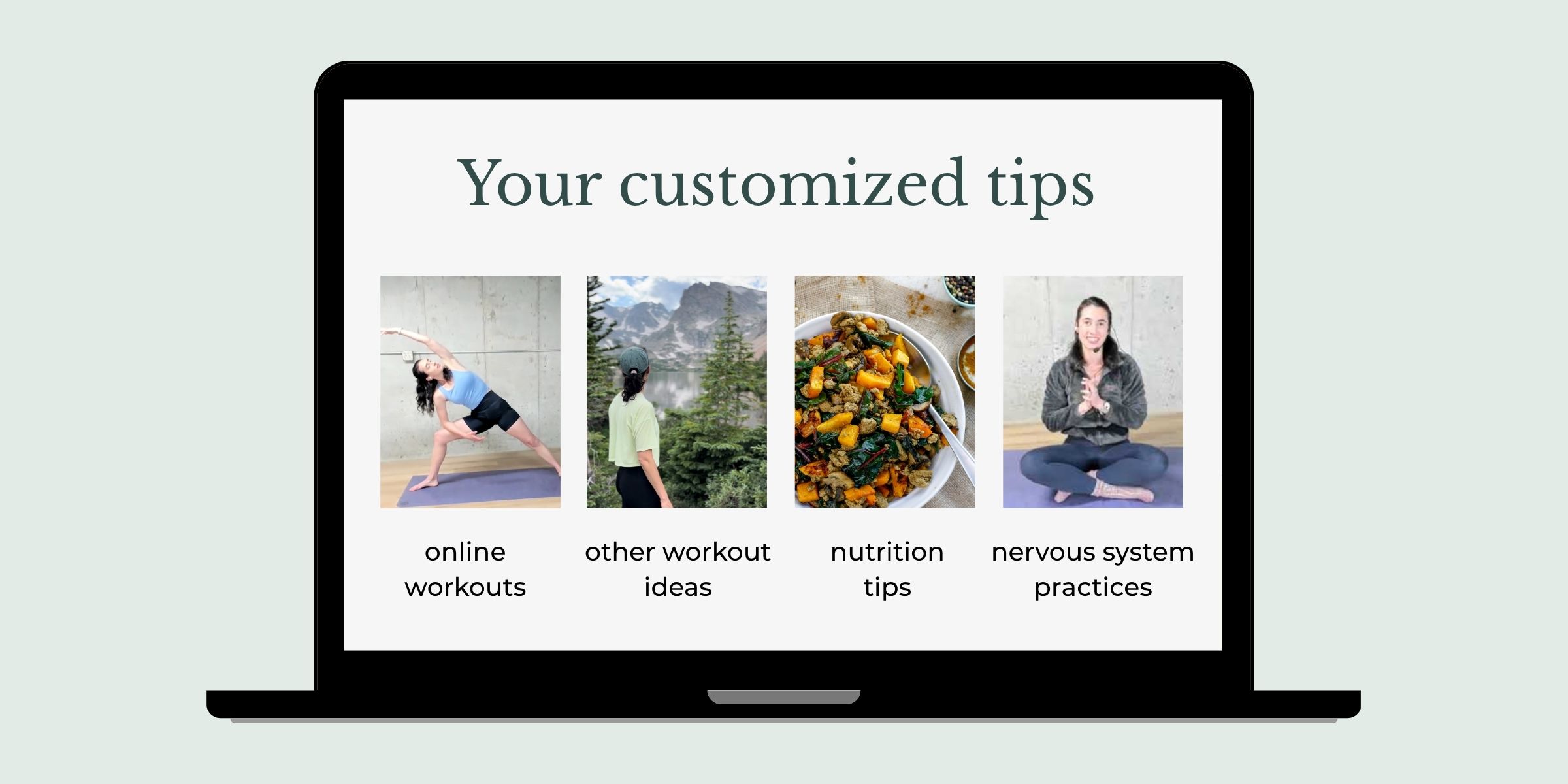
If this feels like a breath of fresh air, this is what my online InSync Fitness studio is all about.
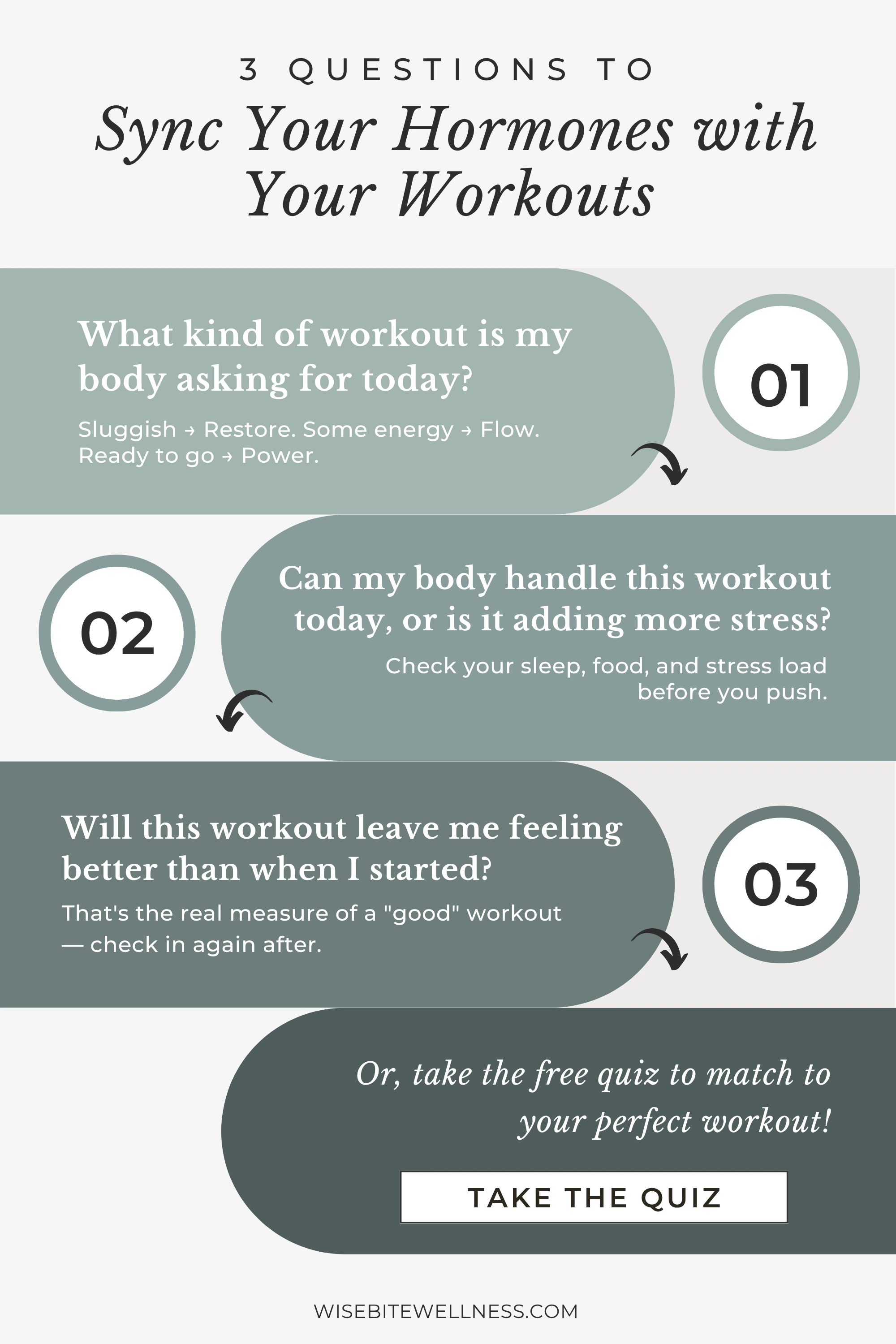
Before every workout, I encourage you to pause for just 30 seconds and ask yourself these three questions. They might seem simple, but they've completely changed the way I — and many of my clients — approach movement.
1. What kind of workout is my body asking for today?
A) I'm feeling sluggish and tired, like I could use a nap.
Rest or gentle movement feels best, like stretching or a short walk.
This is RESTORE.
B) I want to move but I'm not feeling 100% energized.
My body is craving things like barre or yoga flows with dynamic movement.
This is FLOW.
C) I have energy to use today and I'm up for seeing what my body can do.
I’m ready for strength training, long power walking, or something that gets my heart rate up.
This is POWER.
Instead of automatically reaching for the hardest workout or skipping movement altogether because you're not "feeling it", start checking in with your body first. Our capacity for movement isn't a mood; it's constantly influenced by our hormones, nervous system, recovery, sleep, stress, and where we are in our cycle. It's biology.
2. Can my body handle this workout today, or is it adding more stress?
A) Yes
B) No
C) Not sure
Your workout doesn't happen in a vacuum. Think about everything your body has experienced over the last 24 hours:
Did you sleep well?
Have you eaten enough to support today's workout?
Have you been under a lot of pressure today?
Are you recovering from yesterday's workout?
Your body experiences all of those things together. The movement you choose isn't just about whether you can do the workout, but whether your body has the resources to recover and adapt to it afterward.
Exercise is a healthy form of stress — it's what challenges your muscles, heart, and boosts metabolism to become stronger and more resilient. But that only happens when your body has enough energy, nourishment, and recovery to repair and adapt.
3. Will this workout leave me feeling better than when I started?
A) Yes
B) No
C) Not sure
This is probably my favorite question because it changes how we measure a "good" workout — it's thinking ahead about the effects after. Simply ask:
“Will this workout leave me feeling stronger, more energized or relaxed, mentally clear, or in general, better than when I started?”
Of course, you can't know for sure beforehand, but asking this question helps you slow down and think differently before jumping into movement. Then, afterward, check in with yourself.
Over time, you'll start connecting the dots between how your body felt before, the movement you chose, and how you responded. That body awareness becomes second nature.
What your answers mean
Question #1 matches you with a workout phase — RESTORE, FLOW, or POWER. Questions #2 and #3 double-check that your body is ready for that match.
For #2 and #3: If you answered "yes" or "not sure," stick with the phase. “Not sure" just means paying extra attention to how you feel during and after, so you can answer future questions more confidently.
If you answered "no," consider something more gentle, or stick with your match but be mindful of modifications.
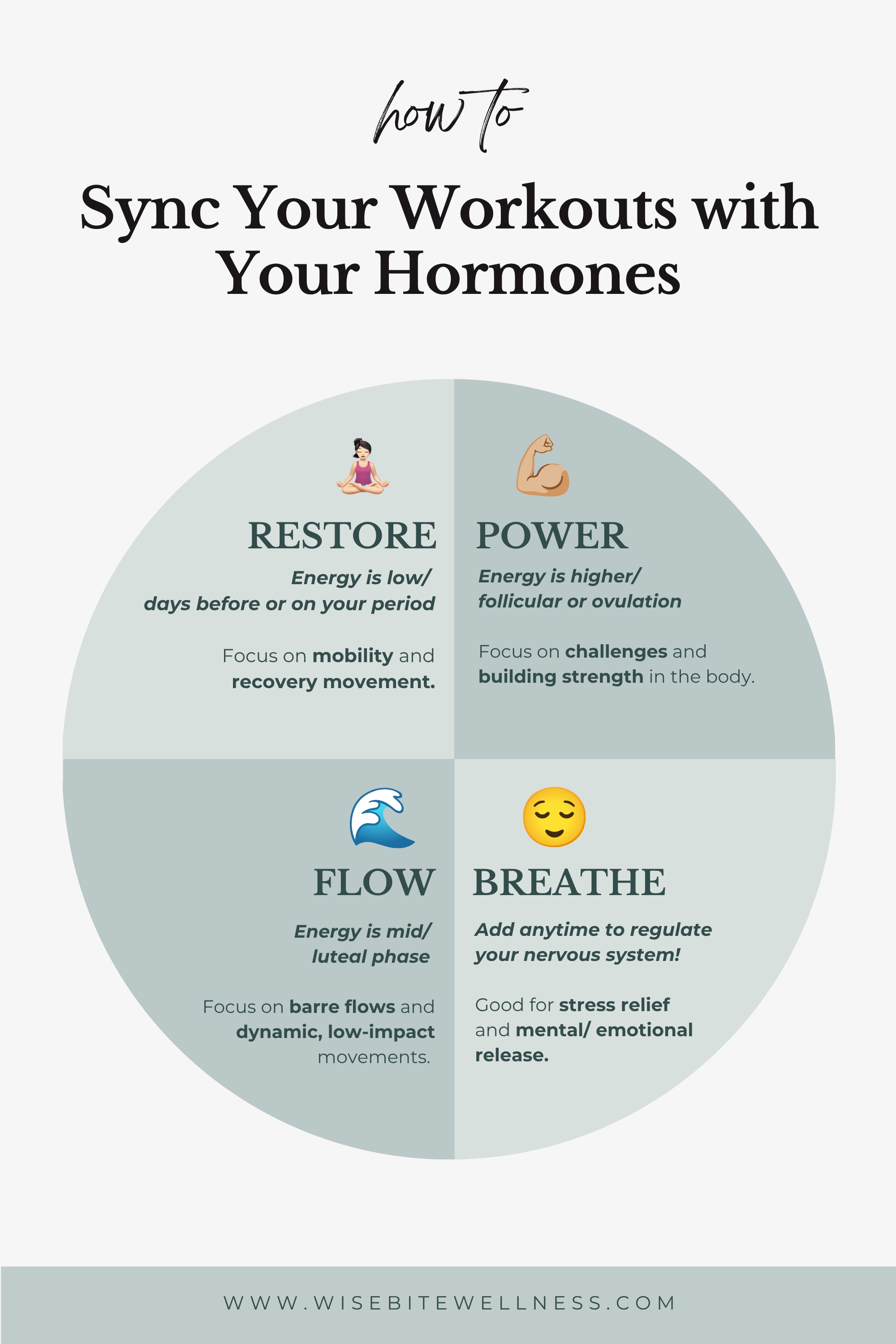
How RESTORE, FLOW, and POWER Match Your Hormones or Cycle
RESTORE
This might mean you're just days before or on your period. Or, you have low energy from things like a stressful day or poor sleep. This is when the body is asking you to slow down so it can work hard to repair and restore.
A RESTORE phase looks like:
Walking, stretching, mobility
Yin/ restorative yoga, foam rolling
Somatic exercises, like legs-up-the-wall
Self-care activities, like a nap or warm bath
Supporting this phase with RESTORE lets your body do what it does best — detox, repair, and rebalance — so that when you move into the next phase, you're energized and ready for more.
FLOW
This might mean you're in a luteal phase. Or, you have energy but it’s not at 100%. Hormones are shifting, and your body still wants good movement that's low-impact without pushing your limits.
A FLOW phase looks like:
Bodyweight or lighter strength training
Power walking, moderate hiking
Pilates, yoga flows, barre, cardio bursts
Moderate-intensity sports, like swimming and tennis
Supporting this phase with FLOW leaves you feeling energized, so when you hit the next phase, your body has an easier time fully restoring.
POWER
You may be in your follicular phase or around ovulation. Or, you've slept well and have higher energy. Hormones often support higher energy and strength here, and you're likely ready to be challenged.
A POWER phase looks like:
Heavy lifting or resistance training
Running, HIIT, uphill hikes, cardio activities
Faster-paced or longer classes, like kickboxing
Higher-intensity sports, like swimming laps and soccer
Supporting this phase with POWER leaves you feeling strong, so when you hit the next phase, you're ready to rebalance and build on what you've started.
What Happens When You Let Your Body Lead
If there's one thing I hope you take away from this article, it's this: our bodies are always responding to the environment we create for them, and that goes far beyond food and exercise. It includes our routines, the pace we live at, the pressure we put on ourselves, and the patterns we repeat without realizing it.
When your body is constantly getting the message that life is asking more than you have capacity to give, it naturally shifts its focus toward getting you through the day.
That means recovery, digestion, hormone balance, and metabolism quietly take a back seat while your body focuses on protecting you.
For a long time, I believed progress came from doing more: pushing harder, staying consistent, following the "perfect" plan. But the big shift came when I stopped trying to control my body and started paying attention to it.
When you begin creating an environment where your body feels supported, it starts responding differently.
Because a calmer nervous system means a body that can repair and finally work at full capacity — digestion, hormones, and metabolism firing on all cylinders.
Let your body take the driver's seat and see the change.

Instagram
Pinterest
Facebook
LinkedIn