

Should Women Do 16/8 Intermittent Fasting? A Nervous-System Approach to Fasting for Weight Loss
3 Steps on how to fast without stressing your body out.
If you're looking into intermittent fasting, like a 16/8 fasting schedule, there's a good chance you're hoping to lose weight and belly fat.
Maybe you've heard that fasting helps your body burn fat, boost metabolism, balance blood sugar, reduce inflammation and high cortisol, improve energy, and so much more.
The truth is, intermittent fasting can be a powerful tool, but here's what most people don't realize:
Intermittent fasting is also a stressor.
Now, that isn't necessarily a bad thing. Exercise is a stressor, too. A workout challenges the body and, when paired with enough recovery, helps us become stronger and more resilient.
Fasting works in a similar way.
The Intermittent Fasting Problem
The problem happens when we add another stressor to a body that is already overwhelmed. (And unfortunately, for women’s hormones, our bodies tend to be more sensitive to stress.)
The body doesn't separate stress into neat little categories. It doesn't care whether the stress is coming from poor sleep, a demanding job, relationship challenges, blood sugar crashes, intense workouts…
Or going long periods without food, especially if you are PMS’ing.
It all gets added to the same bucket and when that bucket gets too full, the body shifts into a protective state. Instead of prioritizing things like digestion, metabolism, hormone balance, and recovery, it unfortunately starts focusing on survival.
I learned this the hard way.
(But don’t worry, I’m going to tell you how to make fasting work for your nervous system.)
When I first tried intermittent fasting for gut health, I wasn't doing anything extreme, but I was still skipping breakfast and eating my first meal around 11am.
After a few weeks, my bloating and constipation got worse, my weight wasn't budging, and I found myself thinking about food all the time.
I remember thinking: "Wait... isn't this supposed to work?"
What I didn't realize at the time was that my body was already dealing with additional stress from my health issues: IBS, SIBO, blood sugar imbalances, anemia, thyroid issues, chronic stress and high cortisol, and a complicated relationship with food.
(And that’s not just a mouthful to list out, but a lot for my nervous system to digest!)
The fact was, my stress bucket was already overflowing.
Intermittent fasting can be an amazing tool, but if your body is already carrying a heavy stress load, it can create the exact opposite result you're looking for.
That's especially important for women to know because our bodies don't operate on the same hormonal rhythm every day.
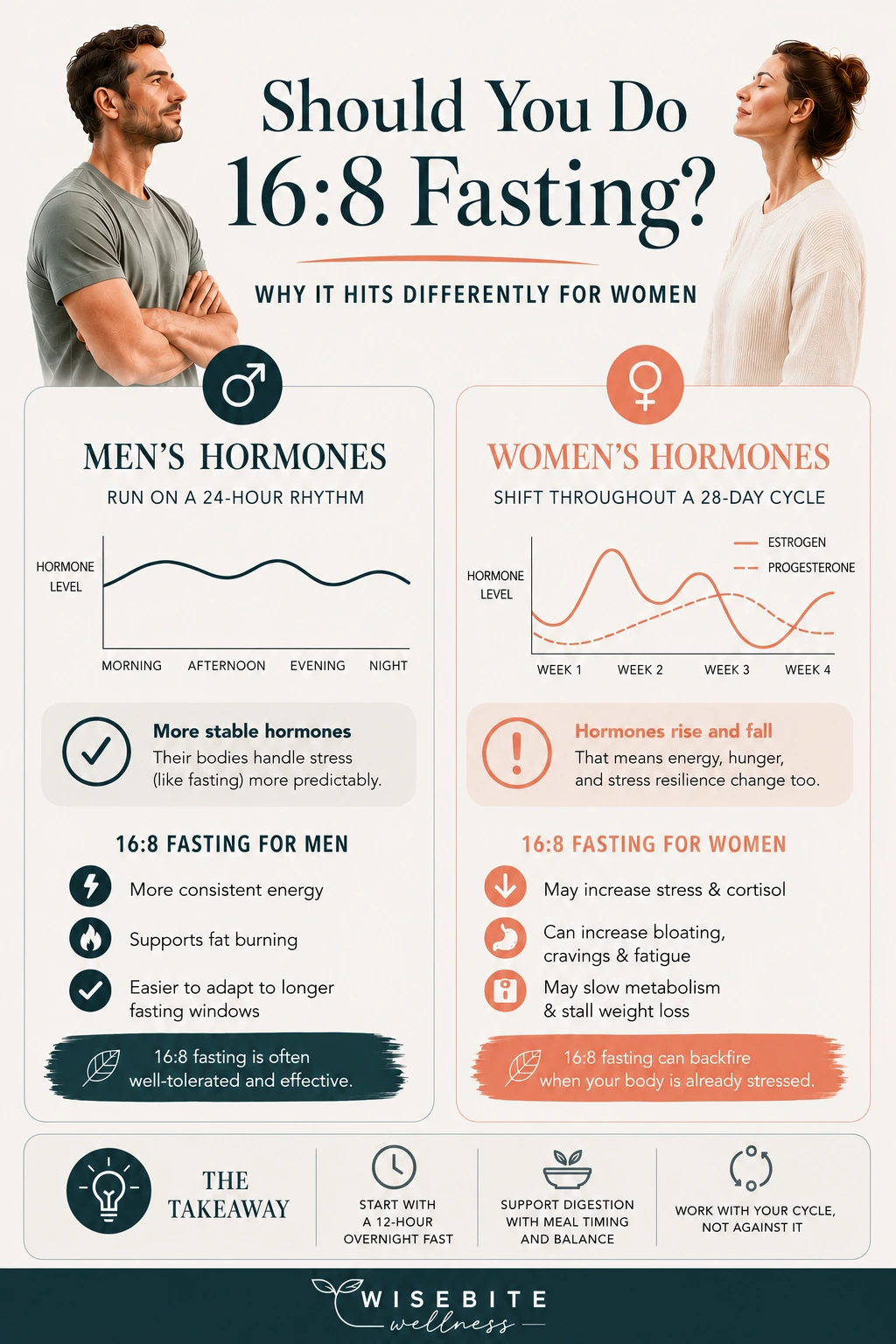
Intermittent Fasting for Women is HIGHLY Cycle-Dependant
Most intermittent fasting advice — especially the popular 16:8 approach — is based on research that has largely been done on men.
Here's the wild part: much of the fasting research we still reference today was done primarily on men. Women were often excluded because their hormone cycles were considered too "complicated" to study and the few research studies that included women didn’t even account for where they were in their cycle.
Your body doesn’t run on the same rhythm every day, like men’s do. Men's hormones follow a more predictable 24-hour rhythm, while women experience hormonal shifts throughout an entire 28-day menstrual cycle.
That means your energy needs, hunger levels, stress resilience, and even how your body responds to fasting can change from week to week.
Some days you may wake up energized and feel great going a little longer between meals. Other days you may wake up hungrier, more tired, or already carrying a higher stress load.
The theory behind intermittent fasting is that when you go long enough without food, your body starts relying more on stored fat for fuel instead of the calories from your last meal. That's one reason fasting has become popular for weight loss.
But unfortunately for many women, instead of improving metabolism, it can leave you feeling more stressed, bloated, hangry, and stuck.
The goal isn’t to force a fasting schedule but to work with your body's changing needs so fasting supports your health instead of creating more stress.
When women support their nervous system first, a simple 12-hour fast can be just as powerful as a man's 16:8 fast.
Because when you focus on your nervous system, you're supporting the system that controls every organ, hormone, and cell in your body.

3 Steps to Fasting without Stressing Your Body Out
Instead of trying to do everything at once, think of this as layers.
Step 1: Start with a consistent 12-hour fast
What I’ve seen work better with women is a simple 12-hour overnight fast which gives you structure without additional mental and physical stress.
So instead of skipping breakfast, you add supportive fuel to your body first thing in the morning. This sets up your body and metabolism for the whole day.
Something like:
Finishing dinner around 7pm
Eating breakfast around 7am
The biggest benefit is that you can do it consistently, even on real-life, busy, stressful days. And most importantly, it’s cycle-friendly without overcomplicating it.
It’s the gentle time-restriction that you can be consistent with that creates a signal of “safety” in your body.
Step 2: Support your digestion with meal timing
When you give your body that overnight break, it has time to fully digest your food instead of going to bed still processing a meal.
That’s a big reason why people notice less bloating and more energy in the morning.
In addition to a 12-hour fast overnight, leaving space between meals during the day (around 3–5 hours depending on the person) allows your digestion to reset.
We’re talking about three meals a day, non-negotiable, with a snack if needed.
There’s a natural “sweeping” process, called the Migrating Motor Complex, that helps clear out toxins and excess. But it only turns on when you’re not eating for at least 90 mins.
So it’s best for your metabolism to stoke the fire with consistent meals, but not grazing on food all day.
This is one of the biggest missing pieces for people struggling with a bloated belly and stubborn weight.
Step 3: Adjust based on your cycle (if you want to do longer fasts)
Your body’s needs naturally shift throughout your cycle and your fasting can shift with it.
After your period (follicular phase):
Energy is higher, so fasting may feel easier. Slightly longer windows (12–14 hours, up to 16 for some) can work if your body feels good with it.Around ovulation:
Energy is still strong. Stick with a balanced approach (around 12–14 hours).Before your period (luteal phase):
Your body needs more fuel. Longer fasts can increase stress and cravings, so a 12-hour fast (or less) is usually more supportive.During your period (menstrual phase):
Keep things gentle. Regular meals or a flexible 12-hour rhythm works best.
Again, you'd want to check in with your body daily so you can get feedback and adjust:
Do I feel more energized or more depleted?
Are my cravings better or worse?
Does my digestion improve or feel more off?
What feels most supportive for me right now?
Those answers are more valuable than any rule or plan you're following.
How to Know if Fasting is Working for You
The most important first step is to know how to listen to your body so you can give it exactly what it needs — and to know what’s working for your body.
Symptoms like weight gain, bloating, and fatigue are your body’s way of crying out and getting your attention that something needs adjusting.
So if fasting isn’t working, your body will tell you. Look out for these signs:
Energy crashes start or get worse.
You're feeling wired but exhausted.
Cravings and feelings of “hangry” grow stronger (especially at night).
Your digestion feels off, more bloating, constipation, or diarrhea.
Skipping breakfast makes you feel worse, and it doesn’t get easier.
Extra weight and puffiness increases or won’t budge.
These symptoms are signs from the body that your nervous system is being dysregulated by intermittent fasting.
Because your body will always tell you what’s working or not… once you start to understand its signs.

Bodies Thrive on Rhythms & Routines
This is the shift that changes everything.
When you eat at consistent times, your body starts to trust that food is coming. That sense of safety affects your metabolism, digestion, energy, and even how your body holds onto weight.
When there’s no rhythm — skipping meals, snacking constantly, eating at random times — your body can store extra belly fat as a safety mechanism for the “famine” it’s predicting from the inconsistency.
This inconsistency and a body not getting what it needs can go into a nervous system state called the sympathetic nervous system, where digestion, energy, and hormones down regulate.
And a body that doesn’t feel safe is more likely to:
Increase cravings
Hold onto extra energy (weight)
Slow digestion and metabolism
This is a state where the body conserves in order to survive — the opposite of what most people are trying to achieve with fasting!
And when your body does feel safe, things start to shift in a way that actually feels right:
You wake up with more steady energy, digestion feels lighter instead of bloated, and your body stops resisting weight loss.
3 Takeaways for Natural Weight Loss
Before jumping into longer intermittent fasting windows, start with the foundations:
Eat 20–30 grams of protein within an hour of waking.
Create a nervous-system-friendly morning routine.
Practice a consistent 12-hour overnight fast.
These three habits help create the rhythm, consistency, and sense of safety your body needs before layering on more advanced fasting strategies.
Remember, the goal is to create the conditions where your body no longer feels like it needs to protect itself.
And that's when metabolism and natural weight loss start to feel easier and natural.

Instagram
Pinterest
Facebook
LinkedIn