

4 Cycle Syncing Mistakes That Made My Period Pain and Bloating Worse
Looking back, I had my hormone health all wrong. My gift to you: learn from my mistakes.
As a fitness instructor for over 8 years, I taught Tae Bo (a form of kickboxing) and Barre3 classes around the Bay Area. Some weeks I was teaching up to five classes, and especially the kickboxing class was a room where I had to bring 100% cardio energy every time.
I remember dragging myself to the gym to teach on the first day of my period because there were no excuses. My hips and muscles would tighten up so much after class.
On top of that, I was restricting food at the time, doing intermittent fasting every day and waiting until dinner instead of eating a snack before teaching, so by the end of class I'd genuinely feel like I was about to pass out.
I'd get home, lay on the floor with period pain for the rest of the evening, and be up all night thinking, "I can't be in this pain every month." And I'd wonder why my periods were at an all-time worst, like it was some kind of mystery.
Here's what I eventually figured out:
I was treating my cycle like something to push through, something to battle and not let slow me down.
I had the same workouts, eating window, and expectations of myself — Every. Single. Day — no matter what. But a woman's hormones and body aren't linear. They run in a circle, with four very different phases, and I was trying to force one flat routine onto a body that was never built for that.
Here are the four mistakes I made along the way, and what I'd tell myself if I could go back.
Mistake #1: Working Out the Same Way Every Day, No Matter My Cycle
My husband and I joined a gym so we'd have something fun to do together, and it turned into two strength classes a week we both looked forward to, consistent right from the start.
But it gets ironic… I didn't listen to my body, which I had so often preached, and this was already after I'd built InSync Fitness around matching workouts to your hormones. I got caught up in the momentum, watching my husband add weight week after week, and kept challenging myself right alongside him, cycle or no cycle.
There was one class during my period where I actually thought about going lighter, because I could feel my body was weaker than usual. But as I started reducing the weight, my husband said, "You can do that weight, you got this!" and without thinking, I did.
My mind told me I did great; my body had been telling me something different the whole time, and I just wasn't listening.
After class, I started seeing bright lights at the edges of my vision, followed by a migraine. Something I hadn't experienced in over a decade.
When I got home, I was frustrated with myself, because "helloooo," I knew better than this! I still pushed straight through the one signal I teach other women to listen to.
That migraine became the moment I finally understood what I'd actually done.
What physiologically is happening
During your period, estrogen and progesterone are both already at their lowest point of the month, which is part of why period migraines are so common in the first place — your brain is more sensitive to any added stress right when your hormones bottom out.
Instead of giving my body room to work with that dip, I added heavy lifting on top of it, which spiked my cortisol and pushed my nervous system into a stress response it didn't have the resources for.
My body was already managing one hormonal shift, and I asked it to manage a second one at the same time. The migraine was my body reaching its limit and telling me so — the reminder I needed to follow my own advice, 100%.
Now, I skip class the week of my period, no guilt attached, even when the instructor sweetly asks if I'm coming next week.
During my luteal phase, I still show up to enjoy class with my husband, but I modify — longer breaks, lighter weight. I just tell him, "babe, I'm in my luteal," and he knows exactly what I mean.
Sometimes the biggest shift and transformation is being your own advocate, without feeling embarrassed or like you're inconveniencing anyone by doing what's actually best for your body.
Mistake #2: Eating on the Wrong Schedule for My Hormones
I jumped on the 16/8 intermittent-fasting wagon because it seemed like everyone around me was doing it and getting results. I skipped breakfast, pushed my first meal as close to noon as I could bear, and kept my eating window tight. It felt disciplined.
Except that's not what happened. I ended up with worse cramps, mood, cravings after dinner, bloating, and constipation. Turns out fasting that long spiked my cortisol and sent my blood sugar on a rollercoaster, and I felt it the most in the days leading up to my period.
It took me a while to realize the problem wasn't intermittent fasting itself — it was that most fasting protocols are built around a roughly 24-hour hormone cycle, closer to how men's bodies work. Women run on a much longer, more variable rhythm, and a lot of us are fasting like we don't have one.
What I do differently now is give my body a much gentler fasting window, closer to 12 hours (most of it while I'm sleeping!) which still allows the body to fully digest and detox.
I also make sure protein is the first thing I eat within the first hour of getting out of bed, instead of coffee on an empty stomach.
That shift alone made a noticeable difference in my energy, and it's been a dramatic one for my clients' blood sugar and A1c levels, too, which showed up in their labs.
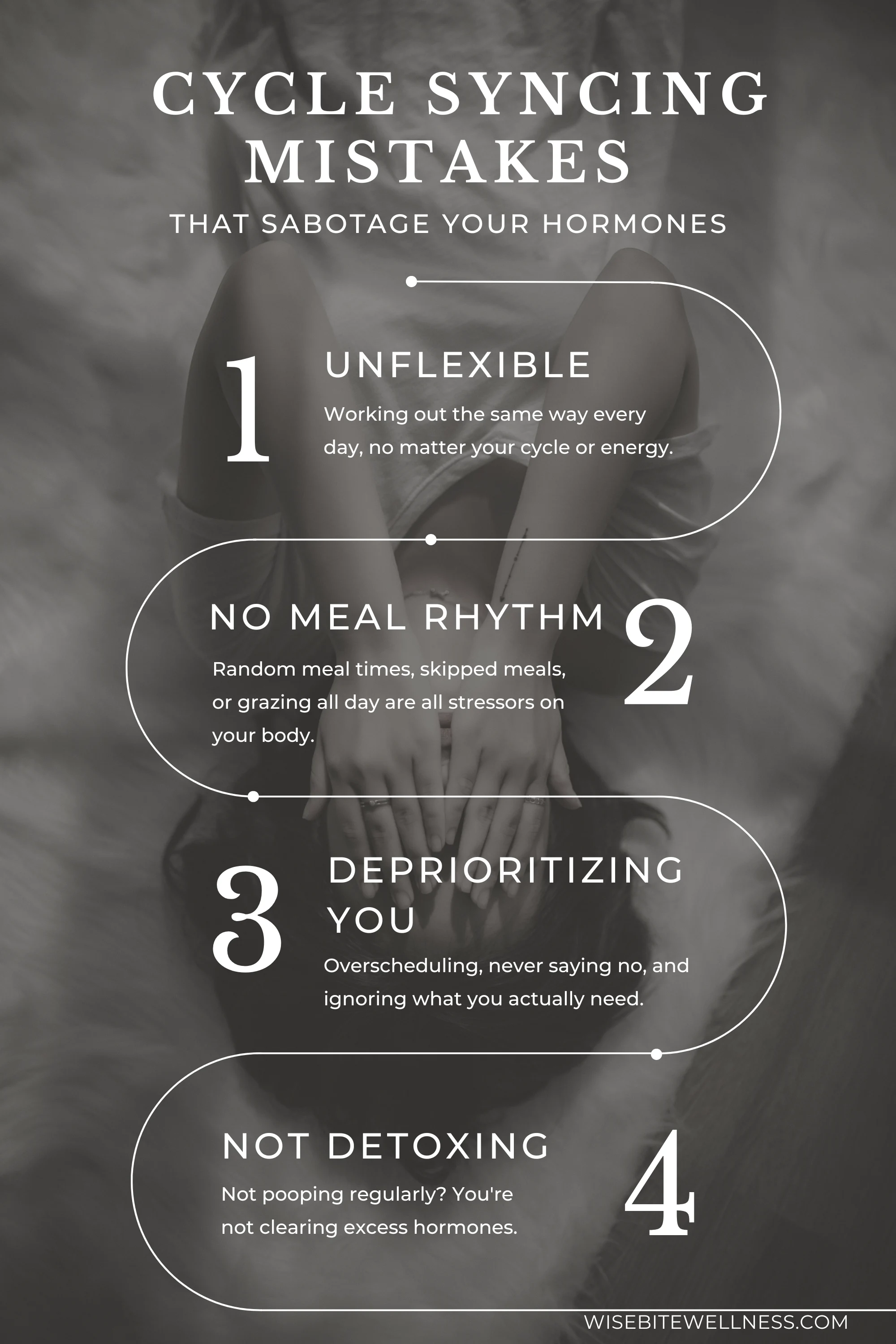
Mistake #3: Putting Everyone and Everything Before Myself
This one is less about food or workouts and more about how I was living. For a long time, rest and boundaries felt like things I had to earn after everything else got done — productivity felt like a pat on the back.
Saying "no" felt uncomfortable, so I mostly didn't. I wore my accomplishments like a badge of honor that said "I'm enough," and slowing down felt like falling behind. I'd answer emails during dinner, say "yes" to plans I didn't have energy for, and tell myself I didn't need rest because I was young. That was a huge factor in why my body crashed when I was 25 years old.
Here's what changed how I think about this:
Most of our productivity culture — early starts, back-to-back output, push through it — is built around a roughly 24-hour hormone cycle.
Which, again, is closer to a male hormone pattern. Women run on a rhythm closer to 28 days, with real shifts in energy and capacity built in. So the standard we've been holding ourselves to was never actually built for us.
A lot of that pushing-through wasn't really discipline. It was a stress response in disguise, looking like productivity:
Needing to control everything and exploding when things fall apart (fight response).
Staying busy so you feel like you're holding it all together (flight response).
Shutting down and avoiding the thing you knew you needed to do (freeze response).
Saying "yes" to everyone because saying "no" felt too risky (fawn response).
Here's the science
Your nervous system can't tell the difference between a work deadline and an actual threat.
Living in fight, flight, freeze, or fawn mode more often than not keeps your body in sympathetic dominance, which keeps cortisol elevated — and chronically high cortisol tells the rest of your body it's not safe to focus on anything but survival.
How sympathetic dominance can show up:
A period cycle becomes irregular or delayed because the body isn't going to prioritize ovulation and reproduction when it thinks it's under threat.
Digestion slows down for the same reason, since breaking down food properly requires a parasympathetic state ("rest and digest").
Your nervous system directs your hormones, not the other way around. And one stuck in high alert keeps signaling your whole body to stay in survival mode.
What I do differently now is treat rest, boundaries, and slowing down as actual hormone tools, not indulgences. Listening to my body and saying "no" when I need to isn't a self-care cliché. It's turning on my parasympathetic nervous system, the only state where healing and repair happen.
Mistake #4: Not Supporting My Gut and Liver's Ability to Detox Excess Hormones
Nobody really likes to talk about this one, but pooping is one of the top ways your body detoxes excess hormones.
I was doing all the "right" things — working out, watching what I ate, taking supplements to "go" — and I was still constipated and bloated every single month.
Your gut and liver are responsible for clearing used estrogen out of your body once it's done its job.
When digestion is sluggish or your liver is overloaded, that estrogen doesn't leave but it gets reabsorbed and recirculated, showing up as bloating, heavier cramps, and moodier cycles.
When you're under-eating, skipping meals, not getting enough fiber or water, or running on stress most of the day — which turns off digestion — that exit route gets sluggish, and your body ends up dealing with more hormones than it actually needs that month.
The most basic starting point is regular bowel movements: enough fiber, water with electrolytes (not just plain water), and whole foods at regular meal times. This matters even more during a luteal phase, on vacation, or during stressful weeks, since all three tend to slow digestion down without you noticing.
What Happens When You Let Your Body Lead
Looking back, none of these were really about willpower. I was working out through cramps, fasting like I didn't have a cycle, saying "yes" to everything, and ignoring what my body was trying to tell me — all while thinking I just needed more control.
The truth is, I didn't need to do more. I needed to understand what my body needed in each phase. Once I stopped treating every day the same, my period pain, bloating, and energy all started to shift in a way no amount of "trying harder" ever managed to do.
When you begin creating an environment where your body feels supported and your nervous system picks up on safety, it starts responding differently.
A calmer nervous system means a body that can finally work at full capacity, where digestion, hormones, and metabolism turn back on.

Instagram
Pinterest
Facebook
LinkedIn